
Research
Ultrafast lasers generally refer to laser pulses with pulse durations shorter than the nanosecond time scale, typically in the picosecond or even femtosecond regimes. Because the laser energy is compressed and delivered within an extremely short time window, ultrafast lasers enable the excitation and probing of physical processes on ultrafast time scales. As a result, they are particularly well suited for investigating the dynamics of electrons, atoms, and molecules, including processes such as energy transfer, charge transfer, and structural rearrangements. In addition, the extremely high instantaneous electric field associated with ultrafast laser pulses is sufficient to drive or even ionize electrons in materials, thereby inducing a variety of nonlinear optical effects.
超快雷射(ultrafast laser)通常指脈衝寬度(pulse duration)短於奈秒(nanosecond)尺度的雷射脈衝,常見的時間範圍包括皮秒(picosecond)甚至飛秒(femtosecond)等級。由於雷射能量被壓縮並集中在極短的時間內,超快雷射能夠在極短的時間尺度上激發並探測物質中的動態過程,因此特別適合用來觀測電子、原子與分子等系統中的超快動態行為,例如能量轉移、電荷轉移以及結構重排等現象。此外,超快雷射所產生的瞬時電場強度非常高,足以驅動甚至游離材料中的電子,進而誘發各種非線性光學效應。
Nonlinear Pulse Compression
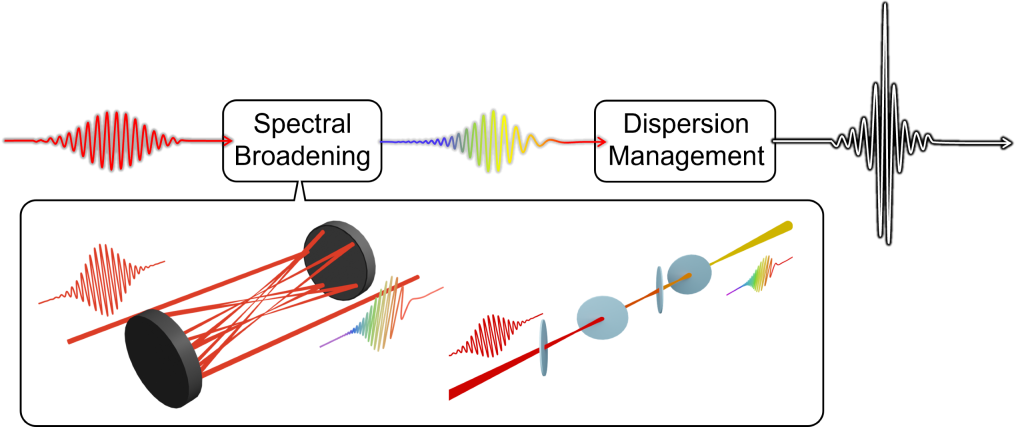
Through nonlinear optical effects, the spectrum of a pulsed laser can be significantly broadened, enabling it to cover a wider range of frequencies. By carefully compensating the phase differences among the various spectral components (e.g., using techniques such as dispersion compensation or pulse compression), the temporal width of the laser pulse can be further shortened to the femtosecond or even sub-femtosecond regime. This combination of spectral broadening and precise dispersion management represents one of the key approaches for generating extremely short laser pulses. The Ultrafast Laser Technologies, Research and Applications Laboratory (ULTRA LAB) focuses on the development of techniques for generating and controlling ultrashort laser pulses. Our research includes nonlinear spectral broadening, pulse compression, and the design and realization of novel ultrafast light sources.
透過非線性光學效應(nonlinear optical effects),脈衝雷射的頻譜可以被有效展寬,使其涵蓋更寬廣的頻率範圍。再經由精確補償各頻率成分之間的相位差,例如利用色散補償元件或脈衝壓縮技術,便能將雷射脈衝的時間寬度進一步縮短至飛秒甚至次飛秒尺度。這種結合頻譜展寬與相位控制的技術,是產生極短雷射脈衝的關鍵方法之一。超快雷射技術與應用實驗室(ULTRA LAB)專注於開發極短脈衝雷射的產生與控制技術,研究內容涵蓋非線性頻譜展寬、脈衝壓縮以及新型超快光源的設計與實現。
Mid-infrared Generation and Application
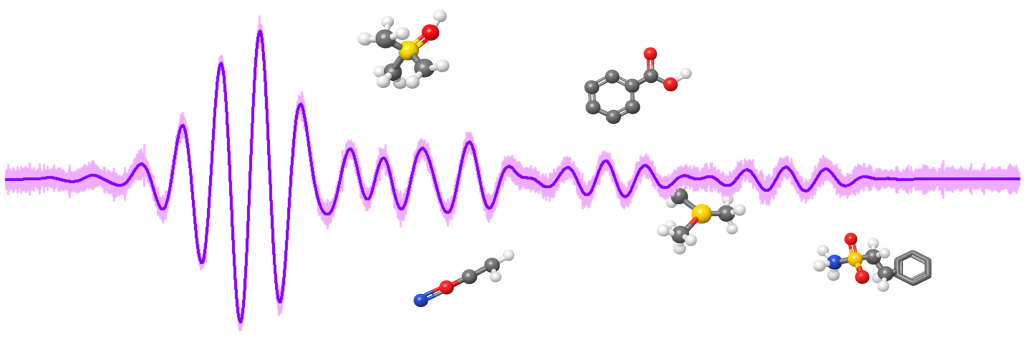
The mid-infrared (MIR) spectral region is often referred to as the molecular fingerprint region, as many molecular vibrational transitions occur within this wavelength range. As a result, MIR spectroscopy provides highly selective information about molecular structures and chemical compositions. This capability makes MIR spectroscopy a powerful tool for applications in chemical sensing, materials characterization, environmental monitoring, and biomedical diagnostics.
中紅外光(mid-infrared, MIR)光譜區域常被稱為「分子指紋區」(molecular fingerprint region),因為多數分子的振動躍遷都位於此波段,使得中紅外光能夠提供高度選擇性的化學與分子結構資訊。因此,中紅外光譜技術在化學分析、材料鑑定、環境監測以及生醫檢測等領域中具有極為重要的應用價值。
When combined with ultrashort laser technology, MIR light enables a new class of ultrafast spectroscopic techniques. Ultrafast MIR spectroscopy allows researchers to directly observe molecular vibrations, energy transfer processes, and charge dynamics on femtosecond time scales, providing critical insight into fundamental light–matter interactions.
當中紅外光與超短脈衝雷射技術結合時,其應用範圍更進一步拓展至超快光譜研究。透過中紅外超快光譜量測,研究人員可以在飛秒時間尺度上直接觀測分子振動、能量轉移與電荷動態等過程,為理解光與物質交互作用提供重要工具。
Beyond spectroscopy, ultrafast MIR laser pulses are also emerging as promising tools for precision laser processing in semiconductor materials. Because MIR wavelengths strongly couple to molecular vibrational modes, they enable selective bond excitation, reduced thermal damage, and the fabrication of novel micro- and nanoscale structures. These unique capabilities open new opportunities in advanced manufacturing and photonic technologies.
除了光譜學之外,中紅外超快雷射亦逐漸展現出在精密半導體材料加工上的潛力。由於中紅外光能有效耦合材料中的振動模式,中紅外雷射可用於選擇性鍵結激發、低熱影響加工,以及新型微奈米結構製作,為先進製造與光電技術帶來新的可能性。
In ULTRA LAB, we will focus on the development of next-generation ultrafast MIR light sources and their applications. By utilizing nonlinear optical techniques to generate broadband and ultrashort MIR pulses, we aim to advance ultrafast MIR spectroscopy, molecular dynamics studies, and precision MIR laser processing. Through these efforts, we seek to expand the frontiers of MIR photonics for both fundamental science and emerging technological applications.
本實驗室致力於發展新一代中紅外超短脈衝光源與相關應用。我們的研究聚焦於利用非線性光學技術產生寬頻且極短的中紅外雷射脈衝,並探索其在超快中紅外光譜、分子動力學研究以及中紅外雷射精密加工等領域中的應用,期望藉此推動中紅外光子技術在基礎科學與工程領域中的發展。